这个系列的一句话主张
PyTorch 不是一个 Python 库,而是一条分层的运行时链路——Python 表达、C++ 运行时、CUDA 执行——每一层各解决一件事;而所有能力(求导、跨设备、编译、分布式)都建立在同一个算子系统之上。
| 线索 | 路径 |
|---|---|
| 抽象线 | Tensor → Autograd → Module → Operator → Compiler |
| 执行线 | Python → C++ → CUDA → Kernel → Hardware |
| 工程线 | Training → Profiling → Distributed → Testing → Build |
读每一篇问同一组问题:这一层的职责是什么、边界在哪、代价是多少。
十篇怎么连起来
%%{init: {"flowchart": {"wrappingWidth": 170}}}%%
flowchart TB
    P1["01 整体介绍:三层运行时链路"] --> T2["02 Tensor 与内存布局<br/>Storage · shape · stride"]
    T2 --> A3["03 Autograd 与动态图"]
    A3 --> M4["04 nn.Module 与训练系统"]
    T2 --> D5["05 Dispatcher 与算子系统<br/>一切能力建立在它之上"]
    A3 --> D5
    D5 --> X6["06 C++ 扩展与自定义算子"]
    D5 --> C7["07 编译执行与图优化<br/>torch.compile"]
    M4 & C7 --> P8["08 性能优化与调试<br/>profiler、Roofline"]
    P8 --> D9["09 分布式 PyTorch<br/>DDP / FSDP / 并行"]
    X6 & D9 --> E10["10 工程体系<br/>一次改动怎么到达用户"]
01 · 整体介绍:torch.add(x, y) 经过了哪几层
结论:六个职责层、一条动态调用路径、四层源码;Autograd 只是 Operator Table 上优先级更高的一个 Key。
%%{init: {"flowchart": {"wrappingWidth": 420}}}%%
flowchart TB
    L1["① 编程接口<br/>Tensor · Autograd 接口 · nn.Module<br/>Optimizer · DataLoader"] --> L2["② 图表示与编译<br/>Dynamo · FX · AOTAutograd · Inductor"] --> L3["③ 算子与分发运行时<br/>Schema · Dispatcher · ATen"] --> L4["④ 设备与通信<br/>内存分配 · Stream · 进程组"] --> L5["⑤ 计算内核<br/>CUDA kernel · cuBLAS · cuDNN"]
要点
- Python 只是表达和控制层;C++ 是运行时和抽象;CUDA 是设备执行——「PyTorch 是一个 Python 库」是第一个误区
- 源码四层
torch/→torch/csrc/→aten/src/ATen/→c10/,依赖只能向下
02 · Tensor 与内存布局:view 只改元数据
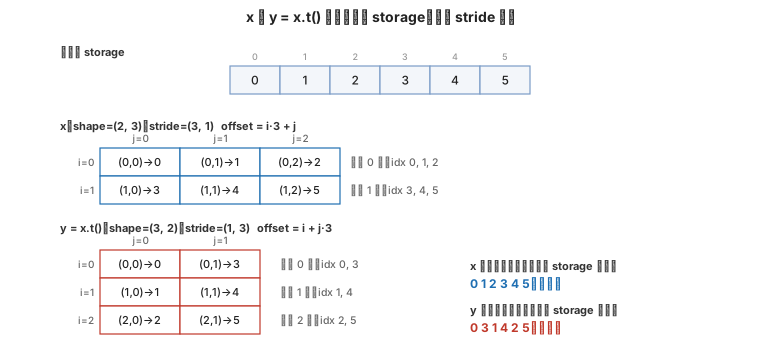
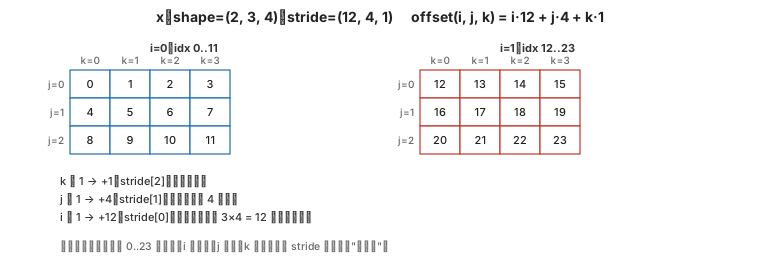
结论:Tensor = 数据 + 形状 + 布局 + 类型 + 设备 + 生命周期;\(\text{offset} = \text{storage\_offset} + \sum_k i_k \cdot \text{stride}_k\);view 只改元数据,contiguous / .to() / clone 才复制。
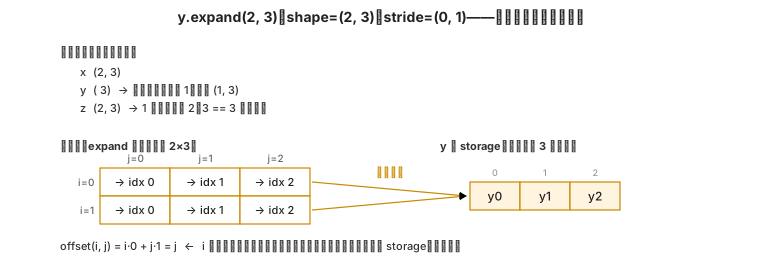
三维 stride 与 expand 的 stride = 0
三个误区
reshape总是零拷贝——不连续时先contiguous()复制再 view;返回值是否共享内存不确定del x后显存就释放了——小 view 仍持有同一 Storage;释放的块只回缓存分配器,reserved不降是缓存不是泄漏allocated与reserved是一个东西——前者是 Tensor 实际占用,后者是分配器向 CUDA 要来的;差值是碎片与缓存
03 · Autograd:链式法则变成一次沿图的反向遍历
结论:前向就地建图,每个 Node.apply 算一次 VJP(不物化 Jacobian),梯度 += 到叶子的 .grad;保存一个输出等于保存整张图。
%%{init: {"flowchart": {"wrappingWidth": 200}}}%%
flowchart TB
    subgraph fwd["forward:数据流"]
        direction LR
        X["x(leaf)"] --> M[["mul"]] --> Y["y = x·x"] --> A[["add 3"]] --> Z["z"] --> S[["sum"]] --> L["loss"]
    end
    subgraph bwd["Autograd 记下的反向节点(next_functions)"]
        direction LR
        sm(["SumBackward0"]) -.-> ad(["AddBackward0"]) -.-> mu(["MulBackward0<br/>saved: x"]) -.-> ac(["AccumulateGrad<br/>→ x.grad"])
    end
    fwd -. "loss.grad_fn" .-> bwd
要点
[B, 4096]的一层若物化 Jacobian 每样本 \(4096^2\) 个数;VJP 只算 \(v^\top J\).grad是累加,所以要zero_grad();version counter 抓 in-place;gradcheck必须 float64
04 · nn.Module 与训练系统:一切状态都在 state_dict 里
结论:__setattr__ 的注册机制决定框架能否发现对象(list 不是 Module,用 ModuleList);Adam 训练每参数 16 字节——7B 模型 112 GB,一张卡放不下的根源。
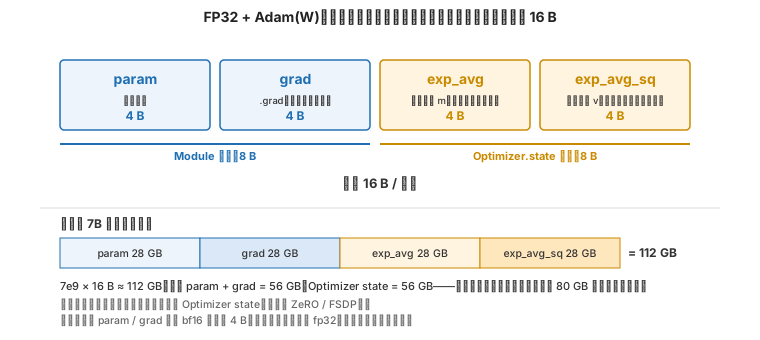
从模型对象到训练循环
%%{init: {"flowchart": {"wrappingWidth": 210}}}%%
flowchart LR
    A["nn.Module 树<br/>__init__ 定结构、forward 定数据流"] --> B["注册机制<br/>__setattr__ 登记 Parameter / 子 Module / Buffer"] --> C["state_dict<br/>属性路径 → Tensor"]
    C --> E["Optimizer<br/>拿 parameters() 用 .grad 更新"]
    F["Dataset → Sampler → DataLoader<br/>pin_memory / non_blocking"] --> G["循环:取 batch → forward → loss → backward → step"]
    E --> G
    G --> H["autocast / GradScaler · Hook · checkpoint"]
model.eval()只切换 dropout / BN,不关梯度——评估要eval()+inference_mode()一起用
05 · Dispatcher:开发态填表、运行态查表
结论:开发态(定义 → 注册 → 实现)与运行态(入口 → 分发 → 执行)交汇于 Operator Table;DispatchKeySet = 各输入 OR + TLS include − exclude,取最高优先级;包装 Key 做完事再次分发——一次 add 两次经过 Dispatcher。
%%{init: {"flowchart": {"wrappingWidth": 200}}}%%
flowchart LR
    subgraph DEV["开发态"]
        direction TB
        A1["定义 Schema<br/>native_functions.yaml / torch.library"] --> A2["注册到各 DispatchKey"] --> A3["编写实现"]
    end
    OT[("Operator Table<br/>算子 → Key → Kernel")]
    subgraph RUN["运行态"]
        direction TB
        B1["入口 torch.add → at::add"] --> B2["分发:查表<br/>KeySet / 包装 Key 再分发"] --> B3["执行:TensorIterator → Kernel"]
    end
    A2 -->|填表| OT -->|查表| B2
要点
- AutocastCUDA → AutogradCUDA → CUDA:autocast 先 cast,autograd 记图,最后 kernel;「Dispatcher 是按 device 的 if/else」是误区
06 · C++ 扩展与自定义算子:三步、两种接入、四个阶段
结论:定义 / 注册 / 实现三步;torch.library 或 TORCH_LIBRARY 接入;Python → C++ CPU → CUDA → Autograd 与 Meta 四阶段;实现层必须处理 device、dtype、stride、生命周期四件事。
| 阶段 | 做什么 | 要处理的 |
|---|---|---|
| 一 · Python 实现 | 先用 torch 算子拼出正确答案 | 作为 oracle |
| 二 · C++ CPU | AT_DISPATCH 展开 dtype、TensorIterator 或 contiguous() |
dtype、stride、空 Tensor |
| 三 · CUDA | blocks = (n + 255) / 256;CUDAGuard 切设备 |
合并访存:warp 32 线程按 32 B 扇区取数 |
| 四 · Autograd 与 Meta | autograd.Function 或 register_autograd;register_fake 给 compile |
gradcheck 用 float64 |
- stride 2 访问带宽利用 50%,最坏多搬 8 倍
- ABI:
_GLIBCXX_USE_CXX11_ABI与 torch 一致,否则符号找不到
07 · 编译执行:torch.compile 到底做了什么
结论:前端 Dynamo 捕获、中端 AOTAutograd 变换、后端 Inductor 生成,共享 FX Graph;运行时靠 Guard 决定复用——能确定的固化进代码,不能确定的变成运行时检查,捕获不了就 graph break 退回 Eager。
%%{init: {"flowchart": {"wrappingWidth": 170}}}%%
flowchart LR
    subgraph RT["运行时:每次调用"]
        direction LR
        CALL["调用"] --> GD{"Guard 成立?"} -->|是| RUN["执行产物"]
        GD -->|否| CA{"缓存命中?"} -->|否| TRIG["触发编译"]
    end
    subgraph CP["编译器:触发时跑一次"]
        direction LR
        DY["Dynamo 捕获<br/>Graph Break 定边界"] --> FX1[("FX Graph<br/>torch 级")] --> AOT["AOTAutograd<br/>反向展开 · 函数化 · 分解"] --> FX2[("FX × 2<br/>ATen 级")] --> IND["Inductor<br/>融合 · 内存规划"] --> CODE["Triton / C++"]
    end
    TRIG --> DY
    CODE --> RUN
要点
- 热路径:3 次分发 → 0 次、3 次 launch → 2 次;Guard
size[0] == 128→s0 > 64;缓存条目上限 8 - 「换 batch size 变慢是编译器 bug」——静态 shape 下每个新 shape 是一次 Guard 失败 + 重编译;
dynamic=True/mark_dynamic
08 · 性能优化:CPU 与 GPU 是两条异步时间线
结论:五类瓶颈——launch / Python / sync-bound(CPU 侧)、memory / compute-bound(GPU 侧)——优化是把瓶颈从一类推到另一类。
%%{init: {"flowchart": {"wrappingWidth": 160}}}%%
flowchart LR
    tl["时间线<br/>torch.profiler / nsys"] --> q1{"GPU 泳道形态?"}
    q1 -->|"稀疏,大段空闲"| q2{"CPU 在忙什么?"}
    q1 -->|"与 CPU 交替空洞"| sync["Sync-bound<br/>批量 .item()、pinned + non_blocking"]
    q1 -->|"密集,首尾相接"| q3{"CUDA 时间被谁占?"}
    q2 -->|"cudaLaunchKernel 占大头"| launch["Launch-bound<br/>增大 batch、融合、CUDA Graphs"]
    q2 -->|"Python / 框架逻辑"| py["Python-bound<br/>向量化、compile"]
    q3 -->|"逐元素与归约"| mem["Memory-bound<br/>融合 / SDPA、bf16"]
    q3 -->|"mm / bmm / conv"| comp["Compute-bound<br/>Tensor Core、减少计算量"]
    classDef cpu fill:#fde9d9,stroke:#c0392b
    classDef gpu fill:#e8f5e9,stroke:#1e8449
    classDef mid fill:#fff4d6,stroke:#b9770e
    class launch,py cpu
    class mem,comp gpu
    class sync mid
案例:五步 166 → 2207 samples/s(13 倍)
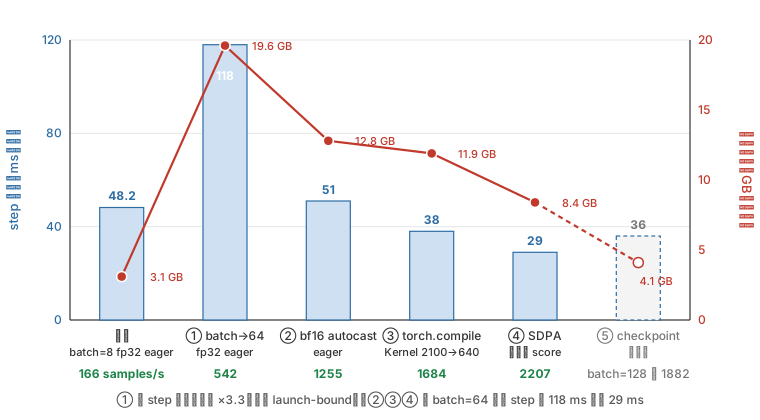
- 「低精度总能加速」——launch-bound 下 Kernel 数不变,autocast 还插入 cast Kernel;先解决 CPU 侧问题,再上 bf16
Roofline:A100
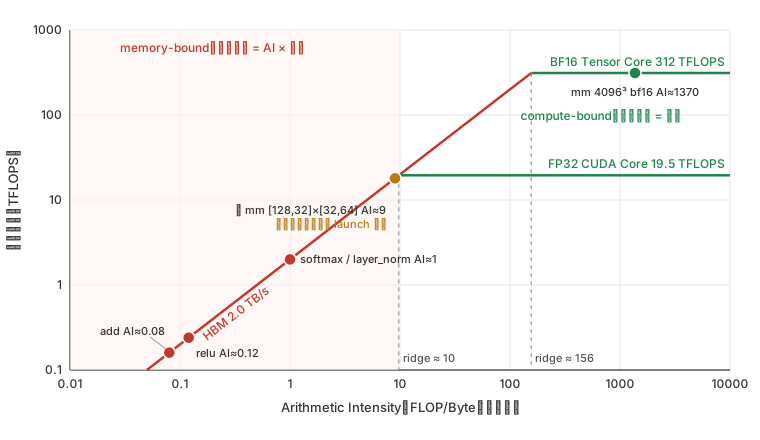
- 融合把 5N 访存变 2N;ridge FP32 ≈ 10、BF16 ≈ 156 FLOP/Byte
09 · 分布式:五类状态各做一个决定
结论:参数、梯度、优化器状态、激活、数据——各选复制还是分片,每个决定对应一种集合通信原语与一个时机;ring all_reduce 每 rank 收发 \(2(N-1)/N \cdot n \to 2n\)。
| 策略 | 每 rank 静态显存 | 每步通信 | 范围 |
|---|---|---|---|
| DDP | 16P | 2P(梯度 all_reduce,按桶与反向重叠) | 任意 |
| FSDP | 16P / N | 3P(all_gather 参数 ×2 + reduce_scatter 梯度) | 任意 |
| TP | 参数 / N | 每层 4 次 all_reduce | 节点内 |
| PP | 参数 / K | 层间激活 | 气泡 \((K-1)/(M+K-1)\) |
- 「FSDP 比 DDP 省显存也省通信」——通信 3P 对 2P 多 50%;省的是 16P → 16P/N
- 「加卡就该线性加速」——带宽项通信量不随 N 减少,per-rank 计算随 N 缩小;藏不住就换策略
10 · 工程体系:一次改动过七关
结论:守住正确性、性能、兼容性;框架工程是在组合爆炸下求可行——2000+ 算子 × 约 15 种 dtype × 设备 × 布局 × 模式 → 几十万测试实例,五种 oracle。
| 关 | 内容 |
|---|---|
| lint / 类型 | 格式、mypy、clang-tidy |
单测(pull 层约两小时) |
OpInfo 驱动,五种 oracle:参考实现、gradcheck、跨设备、跨 dtype、compile vs eager |
| 性能基准 | TorchBench、每日回归 |
| 兼容性 | 弃用保留至少一个小版本(通常两个);ABI 检查 |
| 发布 | 小版本每三到四个月,cut 距发布约 6 周 |
- flaky 测试:自动开 disable issue 隔离、定期重跑、连续通过后恢复——不是让作者重跑到过
gradcheck:数值 Jacobian(float64、中心差分)对解析 Jacobian 逐元素比
五条贯穿线
| 线 | 落点 |
|---|---|
| 一切建立在算子系统上 | Autograd 是一个 Key;autocast 是一个 Key;compile 捕获的是算子;自定义算子填的是同一张表 |
| 元数据 vs 数据 | view / stride / expand 只改元数据;state_dict 是元数据到 Tensor 的映射;Guard 检查的是元数据 |
| 异步与同步点 | CUDA stream 异步;.item() / .cpu() 是同步点;NCCL 走另一条 stream;DDP 桶与反向重叠 |
| 每参数多少字节 | 16 B(4 + 4 + 4 + 4)→ 7B 112 GB → DDP 16P、FSDP 16P/N → 混合精度改这个数 |
| 代价 | CPU 每算子 10–30 µs;VJP 不物化 Jacobian;FSDP 多 50% 通信;compile 缓存上限 8 |
常见误区(一)
- 「PyTorch 是一个 Python 库」——三层分工,Python 只是表达层
- 「
reshape总是零拷贝」——不连续时先复制 - 「
del x后显存就释放了」——view 共享 Storage;reserved不降是缓存 - 「把
loss存进 list 只是保存一个数」——它持有整张图与所有激活 - 「
model.eval()关闭了梯度」——只切换 dropout / BN
常见误区(二)
- 「Dispatcher 是按 device 的 if/else」——多维、可多次的运行时分发
- 「
torch.compile把 Python 翻译成 CUDA」——只捕获可分析的 Tensor 计算,其余变 Guard - 「GPU 利用率低就优化 Kernel」——先看 GPU 泳道:在等 CPU 还是同步点
- 「FSDP 省显存也省通信」——通信多 50%
- 「加卡就该线性加速」——通信、同步等待、计算效率、算法效率四组原因
十个出口
| 篇 | 一个公式 / 一个数 |
|---|---|
| 01 | 源码四层 torch/ → csrc/ → ATen/ → c10/,依赖只向下 |
| 02 | \(\text{offset} = \text{storage\_offset} + \sum i_k\,\text{stride}_k\);expand 的 stride = 0 |
| 03 | VJP 不物化 Jacobian;.grad 累加;gradcheck float64 |
| 04 | 16 B / 参数;GradScaler 65536、÷2、2000 步 ×2 |
| 05 | KeySet = 输入 OR + TLS include − exclude;一次 add 两次分发 |
| 06 | blocks = (n + 255) / 256;stride 2 带宽 50% |
| 07 | Dynamo → AOTAutograd → Inductor;Guard;缓存 8 |
| 08 | CPU 每算子 10–30 µs;ridge A100 BF16 ≈ 156;13 倍 |
| 09 | ring all_reduce 2n;DDP 2P / FSDP 3P;PP 气泡 (K−1)/(M+K−1) |
| 10 | 2000+ 算子 × 15 dtype × …;cut 距发布 6 周 |
下一步
- 往下:《GPU Kernel 工程》——第六篇的 CUDA 阶段展开成一个系列;《ML 编译器》——第七篇的 Inductor 展开
- 往上:《大规模训练》——第九篇的五类状态在几千卡上怎么切;《通信与互连》——NCCL 之下
- 算法侧:《算法工程师的工具箱》第 3–4 篇是本系列的使用层摘要
- 原文总纲:
/deep-dive-into-pytorch.html;通关自测在系列总结